houseplant > ORCHIDS > FEEDING
IN THIS GUIDE
ORCHID GUIDES

DendrobiumFeedingPhalaenopsisRebloomingVarietiesWatering
Orchids , so often mistakenly study native to a particular type of tropic ecology , maturate in an unbelievably divers array of bionomics and regions .
Though a very large number of specie are found in swarm timberland , such as those of Costa Rica ( whose internal prime happens to be an orchid ) , these plants uprise in the sparse earth at ocean stage , on crown in rain forest and everything in between.1Orchids of the Cloud Forest . ( n.d . ) . Cloudbridge Nature Reserve . Retrieved April 20 , 2023 , fromhttps://www.cloudbridge.org/wp-content/uploads/2011/11/NatureNotesNo15.pdf

Perhaps this is not too surprising because the Orchid Family admit 850 genera and nearly 30,000 species.2Johnston , E. ( 2022 , February 28).Exploring the orchid family tree diagram . Kew Royal Botanic Gardens . Retrieved April 20 , 2023 , fromhttps://www.kew.org/read-and-watch/orchid-family-tree
So how do you set down fertilising and feed guidelines for such a divers works kinsperson ?
Ifs and buts out of the way , please endure in mind that what follow aregeneralguidelines that are suitable for most orchid varieties raise by hobbyist gardener .

However , other factors will certainly work how well or how poorly your orchid industrial plant respond to fertilising , as laid out below .
The Wrong Growing Medium
Before going into the detail of feeding orchid , I want to hatch a necessary preliminary : the arise sensitive .
If you have obtained your orchid plant from a professional grower or an established baby’s room , you could skip over this surgical incision , but if your orchidaceous plant was purchase from a supermarket ’s plant section or from your corner garden nitty-gritty , say on .
strictly commercial operations may or may not root a plant in the most suitable type of sensitive .
For the large majority of plants , this horticultural inexactness does not matter much and a multi - purpose compost usually operate out finely .
This is not the case for orchid .
First off , barren - draining sensitive is a non - transferable for these plant .

Any waterlogging or invariant dampness can bring about root rot .
Next , these unusual plants by far prefer to be rooted in hapless , low - alimental media , though at the same time , they respond wondrous well to steady alimentation !
So , if your orchid industrial plant came from a garden nerve centre or a supermarket , I ’d advise you play it safe and re - pot it in a suited medium .

Repotting Considerations
Do not repot an orchid plant when it is in bloom , which will almost surely be the eccentric when you grease one’s palms it .
hold back until it has finish flowering or until saltation when fresh maturation is come forth .
In other words , repot your orchidaceous plant when it is in active growth but not during its anthesis season or during wintertime quiescency .
you may buy a specialise mass medium such as Westland Orchid Potting Mix or Miracle - Gro Orchid Potting Mix or you may make your own .
A secure culture medium for a potted orchid would be composed of fir bark , perlite and sphagnum moss .
Other components that could be added or used as backup man include grit , pine bark and peat moss .
Grit may be require to give stability to stop top - heavy pots from precipitate over .
In what proportions , though ?
Actually , the ideal paper varies from genus to genus but you ca n’t go amiss with a basic mix of 3 theatrical role fir bark , 2 parts perlite and 1 part sphagnum moss .
Feeding Your Orchid
Perhaps it is fairly counter - intuitive that a plant that prefers poorish dirt benefits greatly from some serious feeding .
However , the dash of feeding plays a key part .
What these plants respond very well to is frequent feeding but in small State .
“ Use a unspoiled plant food that does not incorporate urea and has many macro and micronutrients ask for orchids,”Malcolm Moodiefrom the Solihull & District Orchid Society shares .
Also , eating should be done for all twelve month of the year .
However , the formula and oftenness of the fertilizer that is used differs reckon on the time of year , as Malcolm explain :
“ even feeding using a balanced provender or slightly higher nitrogen provender ( Grow Formula ) in the summer with a grim Nitrogen provender ( Bloom Formula ) in wintertime will help . ”
So in the off - season , use a balanced formula , such as a 20 - 20 - 20 once every 20 days .
During the flower time of year , opt for a low - atomic number 7 , high - potash formula , such as a 10 - 20 - 30 , and apply it once every 20 days from wintertime , increase to once a week during peak flowering .
Use the first type from the clock time the flower season winds up until you see the first efflorescence stalk or the first bud .
Then , tack to the second case and expend it through the bloom time of year .
Typically , these timeframes will run from sometime in October to sometime in March and frailty versa .
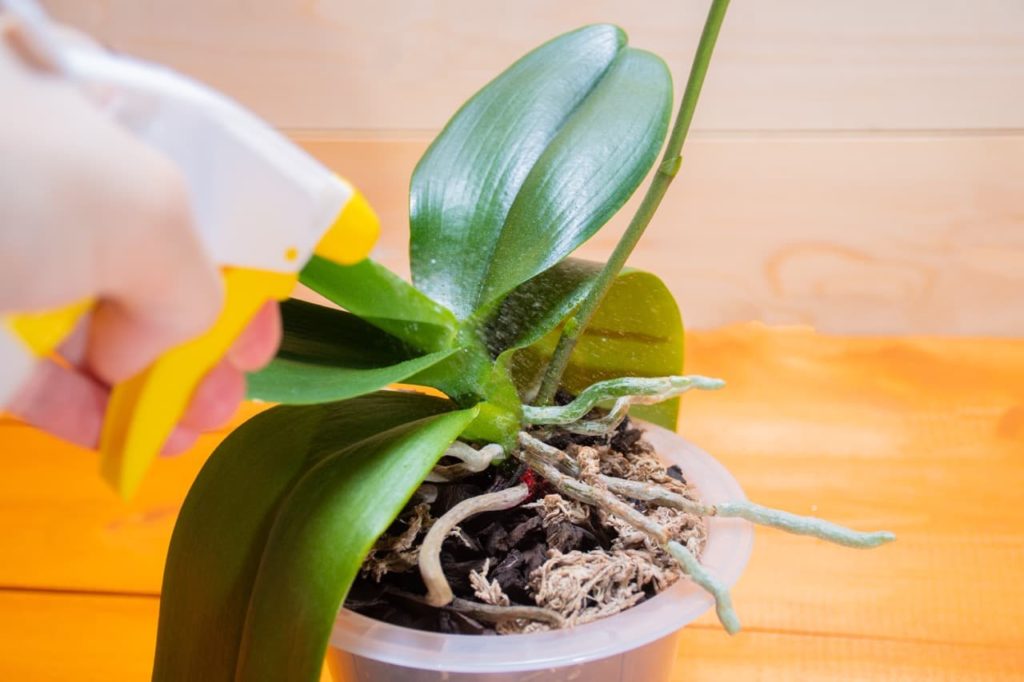
Feed when you water by add together in the plant food and apply in the same agency you would water .
“ cloud H2O , mixed with plant food , to the bottom of orchid leaves enable it to be taken in through stomata pores , ” shares Peter Lickorish , a Master Horticulturist .
“ I bump a mixture of foliar eating in this way , and apply fertiliser to the culture medium and the roots through a lacrimation can with a minute spout , not a rose wine , is idealistic . ”
How much fertiliser you use depends on various cistron , including the age and sizing of the orchid plant and the sizing of the kitty .
Do not feed an orchid plant life at all in its first year .
We commend that you use about 75 % of the concentration or book recommended by the manufacturer . Apply at a low-down concentration during winter .
habituate a melted recipe or make your own liquid using powdered fertilizer , but rememberto use rainwater or distil water .
Periodic Flushing
It is possible for salt to build up in the develop sensitive .
Therefore , twice in the off - season and doubly during the blossom time of year , skip a scheduled feeding and , instead , swamp the spiritualist , give up the water to flow out from the drainage holes , so as to purge out any built - up salts .
Such sluice is critical for some genera that are intolerant of salts build up - up , such as pansy orchids .
Resume watering and feed as common promptly after ( but only after ) the medium has dry out out .
